The automotive sector has always evolved alongside manufacturing technology. From assembly lines to robotics, each shift has reshaped how vehicles are built. Today, 3D printing—also known as additive manufacturing—is redefining car production by enabling faster prototyping, lighter components, and more flexible design possibilities.
Rather than removing material from a solid block, additive manufacturing builds parts layer by layer using digital models. This method allows engineers to produce components that were previously difficult—or impossible—to manufacture using traditional techniques.
How 3D Printing Works in Automotive Manufacturing
In car production, 3D printing involves converting a digital design into a physical object using materials such as plastic polymers, resins, or metal powders. The process typically follows these steps:
-
Digital Modeling: Engineers create a 3D CAD model of the part.
-
Material Selection: Materials range from high-strength plastics to aluminum and titanium alloys.
-
Layer-by-Layer Printing: The printer deposits or fuses material according to the digital design.
-
Post-Processing: Parts may be heat-treated, polished, or assembled into larger systems.
This digital-first workflow enables rapid experimentation without the need for expensive molds or tooling.
Accelerating Prototyping and Design Innovation
One of the most transformative effects of 3D printing is in rapid prototyping. Automakers can now produce and test multiple design iterations in days instead of months.
Companies like BMW and Ford Motor Company use additive manufacturing to create prototype parts for engines, interiors, and aerodynamic testing. Engineers can quickly identify design flaws, adjust dimensions, and print revised components almost immediately.
This shortened development cycle leads to:
-
Reduced time-to-market
-
Lower development costs
-
Greater design freedom
-
Faster innovation in electric and autonomous vehicle components
Lightweighting and Performance Improvements
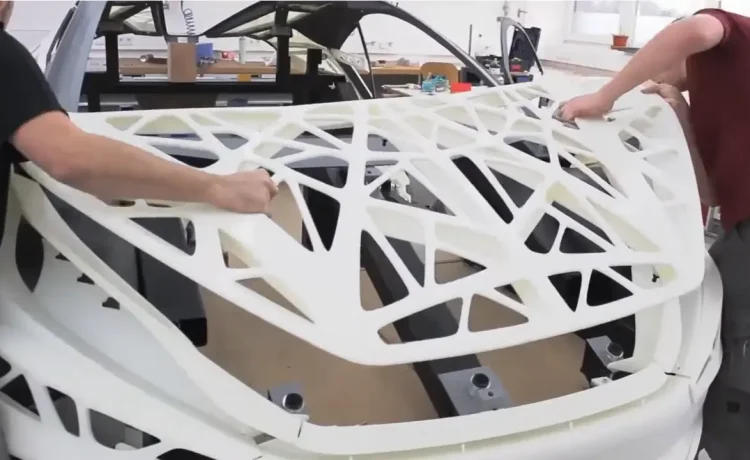
Weight reduction plays a major role in improving fuel efficiency and extending electric vehicle range. 3D printing allows designers to create complex lattice structures that maintain strength while using less material.
Manufacturers such as Porsche have experimented with 3D-printed lightweight seats, while General Motors has developed optimized metal brackets that consolidate multiple components into a single printed piece.
Key benefits include:
-
Improved fuel efficiency
-
Enhanced electric vehicle battery performance
-
Better structural optimization
-
Reduced material waste
By integrating topology optimization software, automakers can design parts that are both stronger and lighter than traditionally manufactured equivalents.
Cost Efficiency in Low-Volume Production
Traditional manufacturing requires costly molds and tooling, making small production runs expensive. 3D printing eliminates many of these upfront costs.
This advantage is especially valuable for:
-
Luxury and performance vehicles
-
Limited-edition models
-
Custom parts for classic cars
-
Replacement components for discontinued vehicles
For example, Mercedes-Benz has used additive manufacturing to produce spare parts for older vehicle models, ensuring availability without maintaining large inventories.
Supply Chain Flexibility and On-Demand Manufacturing
Global supply chains are vulnerable to disruptions. Additive manufacturing introduces localized, on-demand production, reducing dependency on long-distance suppliers.
Instead of storing thousands of spare parts in warehouses, manufacturers can maintain digital inventories and print components as needed. This shift offers:
-
Reduced inventory costs
-
Lower shipping emissions
-
Faster response to demand changes
-
Enhanced resilience during supply chain disruptions
As electric vehicles become more prevalent, this decentralized model may play a crucial role in supporting specialized components.
Customization and Consumer Personalization
Modern buyers increasingly expect personalized features. 3D printing enables manufacturers to offer customized interior trims, dashboard components, and even structural parts without significantly increasing production complexity.
Companies like Tesla, Inc. explore additive manufacturing for tooling and production aids, while smaller manufacturers use it to create bespoke vehicle components tailored to individual customers.
Customization benefits include:
-
Unique aesthetic options
-
Improved ergonomics
-
Faster adaptation to consumer trends
-
Competitive differentiation
Environmental Impact and Sustainability
Additive manufacturing can reduce material waste compared to subtractive processes like machining. Since parts are built layer by layer, only necessary material is used.
Environmental advantages include:
-
Lower raw material consumption
-
Reduced waste generation
-
Shorter transportation routes
-
Potential for recyclable materials
However, energy consumption during printing—especially for metal components—remains a factor that manufacturers must address through renewable energy integration and process optimization.
Challenges and Limitations
Despite its advantages, 3D printing is not yet a complete replacement for conventional automotive manufacturing.
Current limitations include:
-
Slower production speeds for mass manufacturing
-
High equipment and material costs
-
Strict regulatory and safety certification requirements
-
Material performance constraints in high-stress applications
For large-scale vehicle production, traditional stamping and injection molding remain more efficient. Additive manufacturing currently complements rather than replaces these methods.
The Future of 3D Printing in Car Production
As technology advances, 3D printing is expected to expand beyond prototyping into full-scale production of critical components. Improvements in multi-material printing, automation, and metal additive manufacturing will likely increase adoption across the automotive industry.
The integration of artificial intelligence in design optimization and the rise of electric mobility are also accelerating the demand for lightweight, complex components—an area where additive manufacturing excels.
In the coming years, the automotive production model may shift toward hybrid systems that combine traditional assembly lines with additive manufacturing cells for specialized parts.
Frequently Asked Questions (FAQs)
1. Can 3D printing be used to manufacture an entire car?
While prototype vehicles have been fully 3D printed, large-scale commercial production still relies on traditional manufacturing for most structural components due to speed and cost considerations.
2. What materials are commonly used in automotive 3D printing?
Common materials include high-performance plastics, carbon fiber composites, aluminum alloys, stainless steel, and titanium.
3. Is 3D printing cost-effective for mass production?
For high-volume manufacturing, conventional methods are generally more cost-efficient. 3D printing is most economical for low-volume or highly customized parts.
4. How does 3D printing improve vehicle safety?
It enables optimized designs with improved strength-to-weight ratios and allows faster testing of safety components during development.
5. Does additive manufacturing reduce environmental impact?
It can reduce material waste and transportation emissions, though energy usage during printing must be managed effectively.
6. Are 3D-printed car parts durable?
Yes, especially when produced with industrial-grade metal printers. Many 3D-printed components meet or exceed traditional performance standards.
7. How is 3D printing shaping electric vehicle production?
It supports lightweight structures, battery housing innovation, and rapid development of new EV platforms, helping manufacturers accelerate electrification efforts.